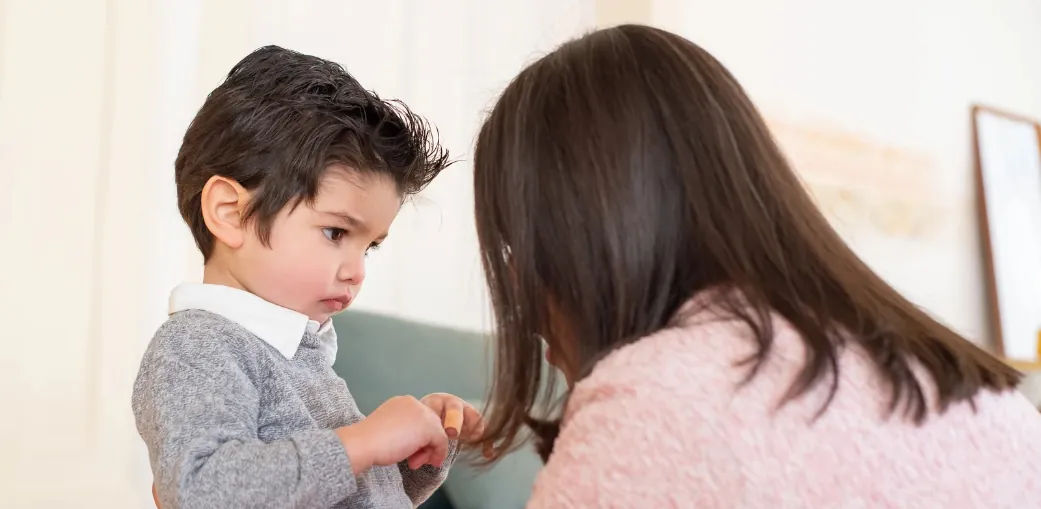
It can be scary when your toddler starts banging their head in their crib or against a wall. But take a deep breath! This is actually a very common behavior in young children. For the vast majority of kids, it’s just a temporary phase they’ll go through. So, why do toddlers bang their heads?
In the younger toddler phase, the rhythmic motion could be soothing to them. Kids can also vent frustration by banging their heads; they don’t have a full vocabulary yet and have limited ways to express themselves. It can even be an attention-seeking behavior, or a way to express physical pain. For most kids, this is no cause for alarm and they’ll grow out of it.
Let’s take a deeper look into why toddlers bang their heads, how you can help them through this phase, and when it’s time for parents to seek professional help.
Why toddlers bang their heads
Head banging is common and usually harmless. It can look distressing to adults, but it’s important to remember that small children naturally lack the strength needed to hurt themselves. Try to look at the world from their perspective. Toddlers are going through huge emotional shifts and physical changes every day. But they have very limited language skills to talk about what they’re feeling. When emotions or physical feelings overwhelm their little systems, they sometimes turn to rhythmic physical behaviors like head banging to express themselves.
Here are some of the most common reasons behind toddler head banging:
1. Rhythmic self-soothing
The repetitive motion of a toddler banging their head in a crib can mimic the soothing feeling of being rocked to sleep in a parent’s arms. The back-and-forth movement helps to calm them down. It’s like a physical mechanism to wind down after a long and stimulating day.
2. Venting frustration
Toddlers are famous for their big meltdowns. When a child experiences a massive surge of anger, it can feel trapped inside their body. A toddler banging their head during a tantrum is often just them externalizing an emotional storm that they don’t have the words to express. The physical feedback helps them release that pent-up pressure.
3. Pain relief or distraction
Sometimes it can be an underlying physical issue that leads to head banging. Teething and ear aches are two of the most common examples of this. They might start banging their head because the sensation distracts from the pain. It’s a way to mask the intense pain in their gums or ear canal.
4. Attention-seeking behavior
Toddlers are like brilliant little scientists when it comes to figuring out how to get attention from mom or dad. They learn very quickly which actions get an immediate response. If they realize that banging their head against a wall brings a parent running into the room, they might repeat the behavior to get that immediate connection. That applies even if the attention feels negative or stressful.
How common is this, really?
If you feel completely alone in dealing with this, the data tells a different story. Pediatricians classify head banging as a “rhythmic movement disorder” of early childhood. It follows a highly predictable trajectory.
According to statistical tracking from the Cleveland Clinic, the timeline of the behavior looks like this:
- Age 9 months: Up to 60% of babies display rhythmic movements
- Age 18 months: Drops down to 33% of toddlers
- Age 5 years: Tapers off almost completely, leaving only ~5% continuing the behavior
When it usually starts and stops
Head banging usually makes its first appearance when a child is around 9 months old. This is when babies are learning how to rock on their hands and knees and experiment with rhythmic full-body motions.
Many kids will grow out of head banging by 18 months of age. The frequency of the behavior tends to peak between 18 and 24 months. This is right around the time when toddler tantrums become more common and they start testing boundaries.
As a child’s vocabulary expands and their brain starts to develop more emotional control, the head-banging impulse starts to go away. By the time most children reach 5 years of age, the behavior goes away entirely without any professional intervention.
Self-soothing vs. tantrum head banging
The two most common scenarios where parents are likely to see a toddler banging their head during a tantrum or when it’s time to go to sleep. The two scenarios come from entirely different places in a child’s brain, and they require different parenting responses.
If the head banging is part of your child’s sleep routine, you’ll notice it when they’re trying to go down for a nap or bedtime. They might appear relaxed or sleepy when the behavior starts. Sometimes they’ll get up and rock on their hands knees, or hum to themselves in a steady rhythm. This behavior can last anywhere from a few minutes to an hour before they fall asleep. Your best response is to simply let them be. You don’t want to step in and disrupt their natural sleep transition.
If a toddler is banging their head against a wall during the day, that’s an entirely different matter. A tantrum can be triggered by any number of things (it often involves the child hearing the word “no”). Head banging during a tantrum is usually accompanied by screaming, body thrashing, and red-faced anger. Toddlers tend to be alone when they bang their head in a crib. In a tantrum, there’s almost always an audience.
Tantrums tend to be short events and will end once the emotional storm passes. A parent’s job is to be calm and protective in these moments. Don’t try to argue or yell over the noise, and don’t give in to whatever demand led to the blowup. Just stay close and create a soft physical buffer to protect their head from injury. Wait it out until they calm down.
Could it be autism?
This is a natural question for parents to ask in 2026, but it’s important to keep the numbers in perspective. Up to 60% of infants will bang their heads at 9 months of age. Meanwhile, autism spectrum disorder (ASD) affects about 3% of children in the US (about 1 in 31). Head banging is much more common than ASD.
For neurotypical children, head banging is a phase they go through during the toddler years. For an autistic child, repetitive behaviors (sometimes called “stimming”) serve as a lifelong tool to help them regulate sensory overload or handle communication challenges. Autism and head banging do sometimes go together, but it’s only part of the puzzle. What changes the clinical picture is the presence of other missing developmental milestones or co-occurring behaviors.
Signs to watch for alongside head banging
The Centers for Disease Control and Prevention (CDC) has official criteria for restricted, repetitive patterns of behavior that can lead to an autism diagnosis. Parents should monitor whether the head banging happens in addition to any of these other developmental markers:
- Communication Gaps: If a child doesn’t respond to their own name by 9 months or avoids eye contact, it can be an early warning sign of ASD. They might also have an inability to share joy or interest with a caregiver. You can read more on early communication markers in our guide to autism symptoms in 9-month-old babies.
- Social Differences: A child might have a clear preference for playing alone, showing little or no interest in interacting with peers. They might fail to use gestures like pointing to show you an object or toy.
- Speech Delays: Significant delays in spoken language development, or repeating the same words and phrases over and over without using them properly (echolalia) are warning signs.
- Rigid Behaviors: A child might become extremely distressed at minor changes in their routine or schedule. They might show intense interest in specific objects or parts of toys (like spinning the wheels of a toy car repeatedly).
- Sensor Processing Challenges: A child might over-react or under-react to sensory inputs, such as being intensely distressed by normal sounds like a vacuum cleaner.
If you’re concerned about your child displaying any of these markers, our Autism Spectrum Disorder Checklist is a helpful resource. You can use it to track developmental markers and share them with your pediatrician.
Keeping your toddler safe in the meantime
Even when you know that head banging is a common toddler behavior, it can still be distressing. Your immediate priority is to keep your child safe while they go through this phase.
If your child bangs their head as part of their sleep routine, move their crib several inches away from any walls. Repetitive motions can loosen screws and bolts in a crib over time. Check it regularly to make sure everything is secure. It can be tempting to line the crib with pillows or soft padding to cushion the impact, but you should never do this. This can present a severe suffocation hazard. A firm, bare mattress is always the safest option.
When your toddler bangs their head against a wall or the floor during tantrums, gently slide a folded towel or your hand under their forehead. You want to catch the impact without pulling them into a physical struggle. Parents sometimes ask about protective helmets when their child is going through this phase. Pediatricians advise against using helmets, unless it’s an extreme situation in which the child is actually hurting themselves. Putting a helmet on a child can increase their frustration and call unnecessary attention to the habit. It can even encourage them to bang their head harder, because the helmet blocks their natural pain feedback mechanism.
When to call your pediatrician
Head banging is almost always a normal part of early childhood development. However, you should call your pediatrician if you notice any of these signs:
- Your child appears to be genuinely injuring themselves, leaving bruises or raw skin.
- The head banging continues during the daytime, even when a tantrum isn’t happening.
- Your child seems disconnected from you during the behavior, or fails to respond when you say their name or touch them.
- The habit persists or gets worse after their fifth birthday.
- You observe any of the broader communication, social, or sensory processing differences listed in the checklist above.
If you and your pediatrician decide that a developmental evaluation is the appropriate next step, it helps to know what the road ahead looks like. For many families, the traditional healthcare route can involve a web of outside referrals and long waiting lists.
EA Schools builds this differently. We have REACH Behavioral Health embedded directly in our Northeast Ohio campuses. If you’re looking into school enrollment for your child and an autism diagnosis is already part of the picture, here’s how our process works:
- Choice at Intake: During our standard enrollment process, you can choose to have your child’s formal autism evaluation handled by the REACH team.
- Early Diagnosis Partnership: EA Schools and REACH partner to eliminate the typical months-long delays. You can secure an early diagnosis for your child in one location.
- Built-in Transition Programs: Because the behavioral health team is embedded in our schools, the diagnosis doesn’t just end with some paperwork. EA Schools uses those immediate insights to build the Coral Autism Program tailored for children who do receive an autism diagnosis.Their educational and behavioral support plan is active from day one.
Frequently asked questions
Is head banging more common in boys than in girls?
Yes, the data shows that boys are three to four times more likely to engage in head banging than girls. Researchers don’t know the exact reason for this difference, but it’s a well-documented pattern in early childhood development.
My toddler screams and bangs their head during tantrums. How can I stop the meltdown?
First, focus on keeping them safe by placing a soft towel or your hand under their head. Avoid yelling or trying to reason with them mid-tantrum. Once it’s over, you can help them practice naming their emotions. For more strategies, see our guide on why autistic children scream and yell.
Should I physically restrain my child to stop them from head banging?
It’s strongly recommended that you don’t restrain your child unless they are in immediate danger. Forcing a child to remain still during a tantrum or a self-soothing cycle can spike their anxiety. It can make the behavior more volatile when you let go. Focus on changing the environment for safety rather than restraining them.
Is head banging a sign of a sensory processing disorder?
Not on its own. Many toddlers seek out rhythmic sensory inputs at some point in their development. The repetitive motions are inherently calming to them.
Does ignoring the head banging make it go away?
If your toddler is head banging during the day to get your attention, a big reaction to it can cause them to repeat it. If the head banging is for attention-seeking, stay calm and quiet, and protect their head with a soft object. Praising them when they use positive words or gestures is the fastest way to extinguish the habit.