
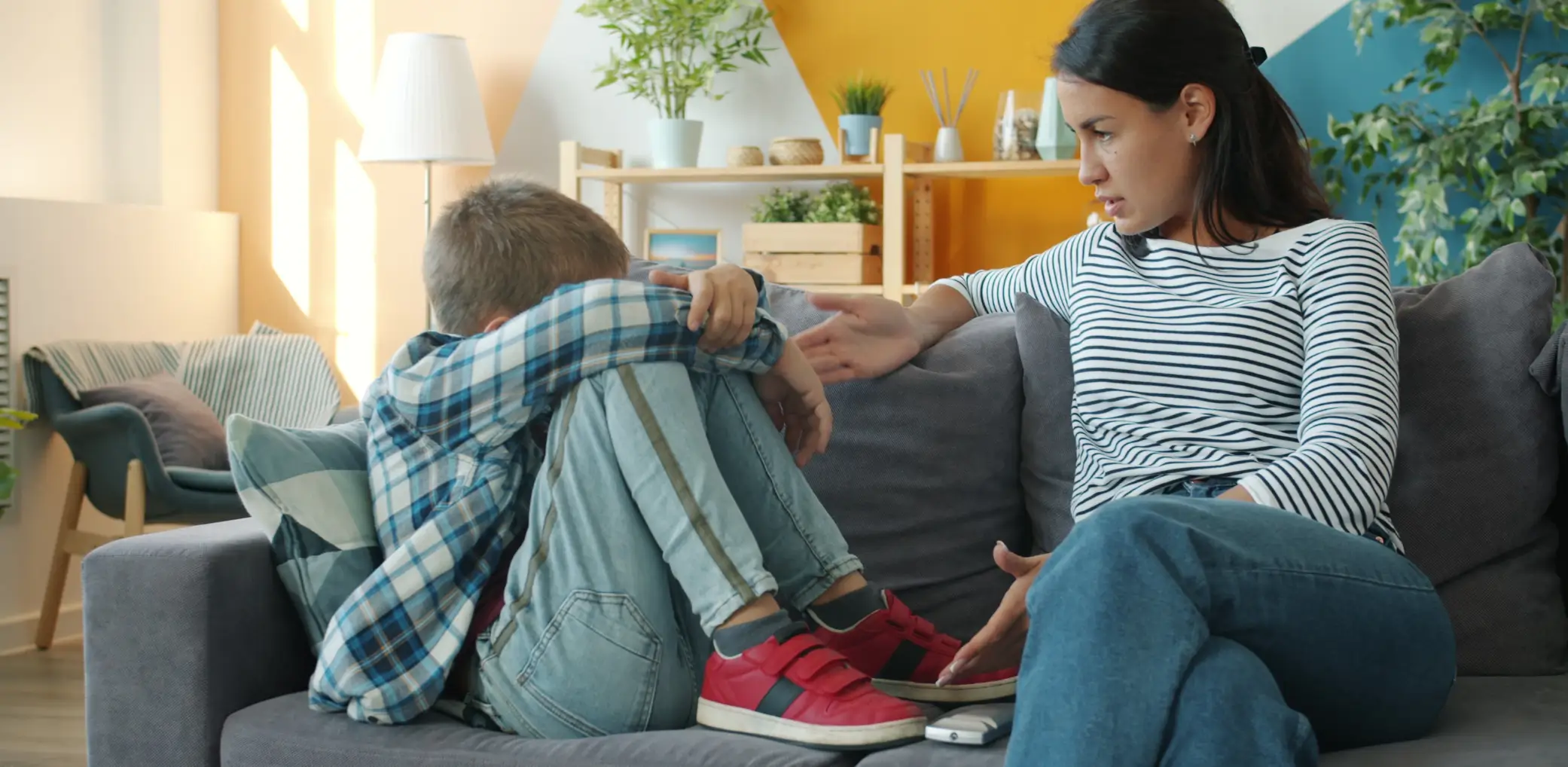
Self-injurious behavior in autism can be one of the most frightening things that parents encounter. Discovering that your child has a bleeding scratch or a fresh bruise can feel overwhelming. One of the most important things to remember is that you don’t want to take the wrong approach to your child’s self-injury. That can accidentally turn it into a reinforced behavior.
Most experts now agree that self-injury in autistic children is a form of communication. The behavior doesn’t mean that your child is broken, or that you’re a failed parent. It means the child is trying to tell you something. This is a behavior that can be understood, and there is real help available.
When you know that your child’s self-inflicted injuries are a form of communication, you can begin the work of teaching them alternative forms of communication. That’s something we specialize in at EA Schools in Ohio, through our Coral Autism Program.
Let’s dive in and explore what self-injurious behavior (SIB) in autism can really mean, and how parents can overcome this issue.
Your child is trying to tell you something
SIB is not an inescapable part of a child’s autism diagnosis. While researchers have found that around 50 percent of autistic children will engage in self-injurious behavior, it’s a medical fact that self-injury is not an official symptom of autism. SIB is a challenge that can co-occur with autism. This distinction is incredibly important for parents to understand. Autism changes how a child experiences the world, but it doesn’t automatically cause a child to harm their own body.
Self-injurious behaviors are often a reaction to an unmet need or an overwhelming environment. A child might feel trapped in a room that’s too loud. They could be experiencing intense frustration because they can’t find the words to say “stop.” When a child lacks a functional way to change their situation, they turn their energy inward. The behavior is a coping mechanism for a brain and body that are completely overwhelmed.
We say all of this to help reassure parents. It’s not something to feel guilty about, and your child isn’t acting out to be malicious. They’re simply using the only tool they have to manage what feels like an impossible moment to them.
Once we stop viewing self-injury as an autism symptom, we can treat it as a message. That’s when the rewarding work begins, which is figuring out what the message is.
First, rule out pain
If your child injures themselves, your first step should be a medical checkup. It’s important to rule out a physical cause for the injury before assuming it’s behavioral.
Autistic children process their internal body feelings very uniquely. They might not process pain the same way that neurotypical children do, and they may lack the words to tell you they have a medical problem.
Sometimes, the message your child is sending is simply, “I hurt.” They might bang their head or hit themselves because they’re trying to distract their brain from an even worse pain inside. Pediatricians recommend checking for several common hidden illnesses right away:
- Ear infections: Fluid and pressure in the ear canal can cause throbbing pain.
- Dental issues: Things like hidden cavities or incoming molars can trigger intense head-hitting.
- Stomach aches: Constipation, acid reflux, and cramping are very common and can cause sudden outbursts.
- Headaches: Migraines or intense headaches can cause a child to strike themselves to cope with the pressure.
Ruling out pain is more critical than ever as the number of families facing these challenges grows. The CDC now estimates that autism affects 1 in 31 children in the US. This updated 2025 statistic shows how common these developmental puzzles are. If you schedule a checkup with your family doctor first, you can make sure you’re not ignoring a physical cry for help.
The self-injury translation table
At this age, autism usually shows up in what your baby isn’t doing – not in unusual behaviors. The signs are subtle. Many parents notice them but second-guess themselves.
The following table shows what some self-injurious behaviors could possibly mean in terms of communication. These are general guidelines that are not carved in stone. Three rules apply to every row in the table:
- The situation is the clue, not the behavior itself. The same behavior can mean different things in different moments. Head-banging isn’t automatically an attempt to “escape.” It depends on what’s happening around the behavior.
- Rule out pain first. Any new, sudden, or intense self-injury deserves a medical check before behavior strategies.
- These are starting guesses, not answers. Track where and when the behavior happens in an ABC Journal. If the behavior continues, ask for a functional behavior assessment (FBA), which we’ll explain below. An FBA can confirm the real reason behind the self-injury.
| Behavior + Situation | Likely Message | What to Try First |
| Head-banging during hard tasks or demands | “This is too hard. Let me out.” (escape) | Lower the demand, offer a real choice, and teach “break” or “help” with words/sign/AAC. |
| Head-banging in loud, bright, or crowded places | “There’s too much coming in.” (sensory overload) | Reduce input, move to a calm space, try headphones; prep before entering with a heads-up. |
| Head-banging when alone, rhythmic, self-soothing | “I need input / I’m under-stimulated.” (sensory/automatic) | Offer safe input — rocking, deep pressure, movement; enrich the space so it’s not empty. |
| Head-banging that’s new, sudden, or with signs of illness | “I hurt.” (pain — headache, ear infection, dental) | Stop and rule out medical causes with an autism-aware clinician before behavior strategies. |
| Hitting self when denied something wanted | “I want that and can’t tell you.” (access to a wanted item) | Teach a fast way to ask (sign/PECS/AAC); respond to the communication, not the hit. |
| Hitting self when routine changes suddenly | “I don’t know what’s coming.” (anxiety/avoiding the change) | Use a visual schedule, give transition warnings, and pre-tell changes with a social story. |
| Hitting self when an adult’s attention moves away | “Look at me / play with me.” (attention) | Give attention for a taught signal (“come,” “play”), not for the hitting. |
| Biting hand/arm during transitions or waiting | “I can’t handle this shift right now.” (escape / overwhelm) | Use countdowns and first-then; offer a safe chew tool or fidget to bridge the gap. |
| Biting hand/arm when overstimulated | “I’m regulating myself.” (sensory) | Offer a chewable (chewelry) and lower the sensory load around them. |
| Scratching self repeatedly in calm/idle moments | “I need something to feel.” (sensory/automatic) | Redirect to alternative tactile input; keep hands busy with a texture toy. |
| Scratching self with a rash, dry skin, or eczema | “My skin is uncomfortable.” (physical discomfort) | Treat the itch/skin; see a doctor — this one is often medical, not behavioral. |
| Scratching that rises with stress | “I’m trying to calm down.” (self-regulation) | Teach a calming routine and a way to signal “I need a break.” |
| Skin-picking when idle or anxious, focused/absorbed | “I’m soothing myself.” (self-regulation; possible anxiety) | Offer a substitute tactile tool, care for/cover the skin, address the anxiety; if it’s hard to stop, ask about an anxiety/OCD evaluation. |
| Hair-pulling when anxious or under-stimulated | “I’m regulating or soothing.” (self-regulation) | Substitute a textured/sensory item and use a calming plan; if urge-driven and persistent, ask about a trichotillomania/anxiety evaluation. |
| Hair-pulling during concentration or tension | “I’m releasing tension.” (self-regulation) | Offer a fidget alternative and build in short breaks during focused tasks. |
This table is a guide for understanding, not a medical diagnosis. Always involve your child’s doctor and care team.
Reading the room
Self-injurious behaviors in autism can be heavily influenced by a child’s immediate surroundings. A room that feels perfectly normal to someone else can feel like a hostile space to an autistic child. A chaotic environment might lead a child to hurt themselves, while a supportive environment can prevent it entirely.
There are four primary environmental triggers that often cause a child to turn their frustration inward:
- Sensory overload: Loud cafeteria noises, bright fluorescent lights, or crowded hallways can trigger physical panic. When a child can’t escape the noise, they may hurt themselves to cope with the stress. A Calming Sensory Room like we use at EA Schools gives them a safe space to lower their stress levels.
- High demands: When academic or social expectations are too hard or fast-paced, a child can become overwhelmed. If they don’t know how to complete a task, they may use self-injury to escape the activity.
- Unpredictability: Sudden changes in daily schedules or a substitute teacher can cause anxiety. Without a clear routine, the world feels unsafe.
- Communication barriers: The biggest environmental trigger is having no way to communicate. If a child cannot express that they’re tired, hungry, or scared, their frustration builds until it boils over into physical hurt.
When you learn to “read the room,” you can spot these triggers early. This allows you to change the environment before your child reaches a breaking point.
Getting a clear answer: the FBA
When self-injurious behaviors in autism continue, it’s time for a professional assessment. A Board Certified Behavior Analyst (BCBA) or a Certified Ohio Behavior Analyst (COBA) can conduct what’s known as a Functional Behavior Assessment (FBA). An FBA is a detailed look at your child’s daily routine to figure out exactly why a behavior is happening.
During an FBA, a behavioral specialist will watch your child in different settings. They look closely at three things:
- The Trigger (Antecedent): What happened right before the self-injury? Was the room too loud? Did the teacher hand them a difficult assignment?
- The Action (Behavior): What exactly did the child do to hurt themselves?
- The Result (Consequence): What happened immediately after the behavior? Did a teacher give them a toy to calm them down? Were they allowed to leave the classroom?
Once the specialist gathers this data, they can create a customized behavior plan. The plan helps teachers and parents change their own responses. The plan is designed to prevent common traps, such as rewarding a challenging behavior. For example, if a child shouts to avoid a hard task, always letting them leave the room might accidentally teach them that shouting is the best way to get a break.
A good behavior plan focuses on changing the environment and teaching new skills so your child can communicate their needs effectively.
How to stop self-injurious behavior in autism
Preventing self-injury requires a step-by-step strategy. We work to actively build a path forward that gives children better tools to communicate. Behavior experts recommend tackling this problem by following a specific order of steps:
- Teach a replacement way to communicate: Self-injury is a message, so we must give the child a safer way to send that message. This can involve using Augmentative and Alternative Communication (AAC) tools, such as an app with communication buttons. It can also include the Picture Exchange Communication System (PECS) or simple sign language. The goal is to let your child say “I need a break” or “This hurts” using words or pictures instead of their body.
- Change the trigger: Once you know what triggers the behavior, you can modify the environment to prevent the meltdown. If a classroom is too loud, the child can be given noise-canceling headphones. If a school assignment is too long, the teacher can break it down into smaller steps.
- Reward the new behavior: When your child uses their new communication tool instead of hurting themselves, celebrate it immediately. Rewards teach them that using words or pictures is the most successful way to get their needs met.
Once these foundational steps are in place, professional therapies can help reinforce their progress. Using structured ABA Therapy can track behaviors and build long-term independence. In some cases, a doctor may discuss medication with you. While medicine cannot teach a child new communication skills, it can sometimes help lower anxiety. This makes it easier for a child to calm down and use their therapy tools effectively.
When it’s an emergency
Self-injury is usually a way to communicate, but it can quickly become a medical emergency. Parents must act fast if they notice severe physical damage, such as deep cuts or dark bruising. They should also watch for physical changes like sudden swelling or vomiting after head-banging, which can point to a concussion. If your child begins hiding sharp tools or completely isolates themselves from the family, seek immediate professional help.
While most of these behaviors are done to manage sensory feelings, researchers have found a co-occurrence between self-injury and suicide risk in autistic individuals. Autistic children can experience high levels of hidden depression or anxiety. They struggle to express deep emotional pains with words, so their risk of severe self-harm can increase.
You can call or text the 988 Suicide & Crisis Lifeline at any time. The service is free, confidential, open 24 hours a day. In Ohio, you can also text 4HOPE to 741741 to connect directly with a local crisis counselor.
Finding the right autism school in Ohio
Finding the right school environment means everything when you’re dealing with self-injurious behavior in autism. Many parents understandably worry about how their child will be treated during an intense emotional meltdown. You should know that you have strict legal rights in Ohio that protect your child’s dignity and safety at school.
Ohio law strictly limits the use of physical restraint and seclusion. Schools are legally banned from using these methods as a form of punishment. They can only be used during an emergency when a student is in immediate danger of physically hurting themselves or others. The state completely bans any restraint that hurts a child or restricts their breathing. If a school ever has to use an emergency intervention, they’re legally required to notify you within 24 hours.
A great school works to proactively prevent these emergency situations entirely. Our classrooms at EA Schools are designed to prevent crises before they ever start. We keep our learning spaces small, with a maximum of 12 students per classroom and a 1:6 staff-to-student ratio. We make sure your child always has a high level of supervision and care from professionals who understand their sensory triggers.
If your child is struggling in your local public school, you have choices. Through Ohio autism scholarships, families can fully fund a specialized school placement. Programs like the Ohio Autism Scholarship and the Jon Peterson Special Needs Scholarship give you the power to direct your child’s state education funds toward a specialized campus like ours. Your child can receive the expert behavioral support and safe environment they deserve at no extra cost to your family.
Contact EA Schools today to schedule a personal tour of one of our Ohio campuses: Bedford, Brook Park, Cuyahoga Falls, Elyria., Painesville Township, Ravenna, Akron/Springfield, or to learn more about our Coral Autism Program.
What parents often ask
Why does my autistic child hit himself / bang his head?
It’s usually a form of communication. When a child can’t find the words to say “stop,” “this is too hard,” or “I hurt,” they may turn that overwhelm inward. Head-hitting or head-banging can signal escape from a demand that’s too hard, sensory overload, a need for input, or a request for attention – and sometimes it simply means “I’m in pain.” The situation it happens in is the clue to what your child is trying to say.
Is self-injury a symptom of autism?
No. Around half of autistic children engage in self-injury at some point, but it is not an official symptom of autism. It’s a challenge that can co-occur with autism. Autism changes how a child experiences the world; it doesn’t automatically cause a child to harm their own body. Self-injury is a reaction to an unmet need or an overwhelming environment – which means it can be understood and addressed.
What causes it?
Self-injury is typically a reaction to an unmet need or an overwhelming environment. Common drivers include hidden pain (ear infections, dental issues, stomachaches, headaches), sensory overload, demands that are too high, unpredictability, and, most often, having no functional way to communicate. When a child can’t change their situation with words, they may turn their energy inward to cope.
How do I stop it?
Start by ruling out a medical cause with your doctor. Then follow three steps in order: teach a replacement way to communicate (AAC, PECS, or sign language, so your child can say “I need a break” instead of using their body); change the trigger (for example, noise-canceling headphones or breaking a task into smaller steps); and reward the new behavior every time your child uses it. If the behavior continues, a functional behavior assessment (FBA) can pinpoint exactly why it’s happening and guide a plan.
How common is it?
Research has found that around half of autistic children will engage in self-injurious behavior at some point. It’s a widespread challenge, and it’s becoming more relevant as autism diagnoses rise – the CDC now estimates that autism affects 1 in 31 children in the U.S. (2025).
Can medication help?
Sometimes. Medication can’t teach a child new communication skills, but it can sometimes lower anxiety enough to make it easier for a child to calm down and use their therapy tools effectively. It’s a decision to discuss with your doctor, and it works best as a support alongside communication teaching and environmental changes – not as a standalone fix.