
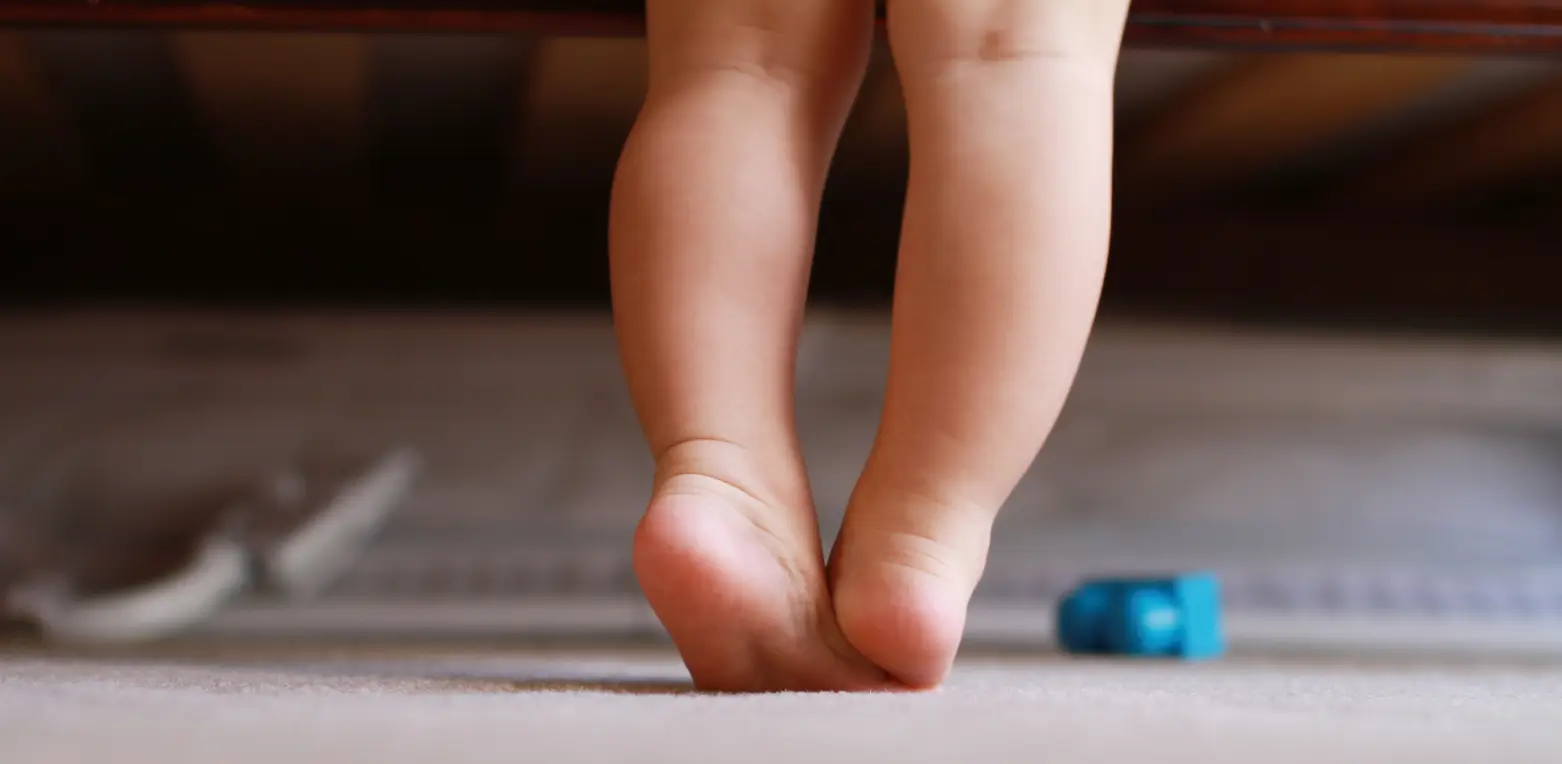
One of the most common questions we hear from parents is: Is walking on your toes a sign of autism? Yes, walking on your toes can be one of a set of early indicators of autism spectrum disorder (ASD), but it doesn’t paint the full picture.
Every parent watches their child’s first steps with pride. Those unsteady wobbles and the pure look of joy in their eyes are something you never forget. But what happens when your child grows and their steps don’t look like other children’s? If your child is tip toe walking constantly, it’s natural to start feeling anxious about it. However, it’s important to understand that walking on the toes is also a common behavior in children with other developmental differences. Understanding the “why” behind it can help you start proactively supporting your child.
EA Schools believes in meeting families exactly where they are. Our specialized Coral Autism Program helps parents navigate these early developmental puzzles. We provide a compassionate and structured environment where kids across Northeast Ohio can thrive. Here’s what parents should know about tiptoe walking and autism.
Why a Child Walks on Tiptoes and Autism
To understand the connection between autism and toe walking, we have to look at sensory processing. When a neurodivergent child walks, they experience the world very differently from the rest of us. For example, an autistic walk on the toes is rarely something that formed as a habit. It’s usually a direct reaction to how they perceive textures and balance.
Research from the European Pediatric Orthopaedic Association shows that many kids on the spectrum experience what’s called “tactile defensiveness.” This means they can be highly sensitive to how things feel on their skin. The sensation of their heel touching a cold floor or rough carpet can feel completely overwhelming. Walking on their toes minimizes how much of their foot touches the ground. It’s a defensive move for the child, because it helps them avoid touching surfaces that feel uncomfortable to them.
The same European study found that other children walk on their toes because they’re looking for extra sensory feedback. They need strong signals from their muscles and joints to understand where their body is in relation to the space around them. Raising onto their toes tightens the calf muscles. That tightened feeling in the muscles sends a signal to the brain that helps the child feel grounded and safe as they’re walking.
Tiptoe walking beyond the spectrum
It’s important for parents to understand that tiptoe walking is a broad subject. Walking on tiptoes does not necessarily mean your child is autistic. Delayed childhood speech isn’t necessarily autism, and the same applies to tiptoe walking. Many different types of kids walk this way at times, but not all of them are neurodivergent. In fact, walking on their “tippy toes” is a normal phase most children will go through as they’re learning how to move around.
When toddlers learn to walk, they do a lot of experimenting with balance and muscle control. It’s common to see them switch between walking on flat feet and tiptoes as they practice. For most kids, tiptoe walking stops on its own as their muscles grow and they figure out their balance. However, if the behavior continues past the toddler years, it’s wise to look into it. This is especially true if you notice other developmental delays.
Signs of autism: walking on tiptoes
The signs of autism are much broader than simply walking on tiptoes. An autism diagnosis depends on a group of behaviors, rather than just looking at the child’s feet. One physical habit like toe walking by itself almost never means a child has autism. Specialists will instead look for a pattern of behaviors:
- Social behaviors: A child might play alone, avoid eye contact with others, or struggle to interpret facial expressions.
- Communication hurdles: The child might have delayed speech, or they’ll repeat words out of context over and over.
- Repetitive motor movements: This includes behaviors like hand-flapping or rocking back-and-forth.
- Anxiety in social settings: Some kids experience high stress from loud or unfamiliar settings. (See: Is It Autism or Anxiety?)
- Rigid routines: A child might get very upset over tiny changes in their daily schedule.
‘Autism feet’ and sensory needs
You might sometimes hear the term “autism feet” used by parents and teachers. This term describes several unique physical habits that affect the legs and feet of some kids on the spectrum. The nervous system of an autistic child processes physical feelings differently. A child’s feet can become a focus for sensory feedback. It can also be a way for them to express their emotions. If an autistic child is walking on their tiptoes, they might be trying to tell you something.
The feet can also be used for physical stimming. Some autistic children flap their hands when excited. They might tense their toes or flex the arches of their feet as well. This can be a healthy physical release for big feelings. Other autistic children use their feet for “grounding.” If a room gets too loud or bright, causing sensory overload, curling their toes into the floor can help anchor them. It helps them feel stable during moments of high stress.
Webbed toes and autism: a niche concern
When you start researching toe walking and autism, you might stumble upon discussions about webbed toes (syndactyly). Finding any unusual feature on your child’s body can be a cause for concern, but it’s important to approach this topic with facts.
Webbed toes are a common physical variation where two or more toes are joined. It happens while the baby is in the womb. Most of the time, this is just an isolated trait that’s genetically passed down through families. Webbed toes don’t affect brain development or how a child thinks.
In very rare cases, webbed toes can be part of a larger genetic syndrome. Some of these rare syndromes can include autism. Having webbed toes does not cause autism. They’re not a standard symptom of the condition. If your child has webbed toes but is meeting all of their other milestones, the toes are just a cosmetic trait. They’re not related to autism.
Toe walking and ADHD
Toe walking is not just an autism trait. Researchers have also found a co-occurrence between idiopathic toe walking and ADHD. Children with Attention-Deficit/Hyperactivity Disorder (ADHD) often have sensory challenges similar to autism. The reason they walk on their toes can come from a different need, though.
Many kids with ADHD have a lot of hyperactivity and strong motor impulses. They might walk on their toes because their body wants to move faster. Bouncing on their toes satisfies a need for constant movement. It also stimulates their balance system. This physical stimulation can actually help a child with ADHD focus better on their teacher or schoolwork.
These symptoms overlap, so a child can have a dual diagnosis of both autism and ADHD. Regular public schools often struggle to help students who need both sensory help and behavioral support.
Through our specialized Day Treatment Program (ADHD), EA Schools combines schoolwork with therapy. We never punish a child for their need to move. Instead, we build in regular movement breaks and practice Unconditional Positive Regard. We keep our class sizes small, with a maximum of 12 students per classroom and a 1:6 staff-to-student ratio. This helps these amazing students use their energy productively while working to succeed in school.
Tip toe walking and autism FAQs
At what age should a child stop walking on their toes?
Most kids experiment with toe walking when they’re first learning their balance. This is usually between 12 and 24 months of age. Walking on tiptoes should generally stop by around age two. If it continues past their second birthday, it’s a good idea to mention it to your pediatrician.
Is toe walking always a sign of autism?
No. Many children walk on their toes out of habit or for physical reasons that can clear up on their own. It only points to autism if it appears alongside other symptoms like communication struggles and repetitive behaviors. In some kids, toe walking could be idiopathic, or it might be due to an orthopedic issue, like a short Achilles tendon or a muscle imbalance. Some kids just develop a habit of toe walking when they’re toddlers. It might take them a little longer to stop, even though their brains are developing normally.
Is toe walking linked to ADHD?
Researchers have found a co-occurrence, as mentioned, but the link to ADHD is less clear than the one with autism. Kids with ADHD often struggle with sensory processing and hyperactivity. Walking on their toes could be a physical sign of their high energy, but in many cases, it’s an idiopathic condition (no known medical cause).
When should I see a doctor about my child’s toe walking?
You should talk to a professional if your child is over two and spends more than half their walking time on their toes. You should also seek help if they complain of physical pain in their legs, or if they can’t stand flat-footed when you ask them to. Call your doctor if the toe walking happens alongside speech delays.
How do I get my child evaluated in Ohio?
Getting an evaluation in Ohio depends on your child’s age and your goals:
- Under Age 3: You can contact Help Me Grow (Ohio’s Part C early intervention program). This path is entirely free and doesn’t require a prior medical diagnosis to receive support.
- Age 3 and Older (School Route): You can contact your local Ohio public school district and request a free Evaluation Team Report (ETR). This serves as an educational eligibility determination for school accommodations, but it’s not a medical diagnosis.
- Any Age (Private Route): You can seek a private diagnostic evaluation through REACH Behavioral Health. At REACH, ADOS-2-based assessments are administered by a Board Certified Behavior Analyst. All diagnostic decisions are reviewed and signed off by Dr. El-Dabh, a board-certified psychiatrist. No doctor referral is needed, and it can be billed directly to insurance. REACH Behavioral Health is embedded in EA’s schools, so students receive psychiatry, individual counseling, and behavioral support from licensed clinical staff working alongside their teachers.
Nurturing growth at EA Schools
If sensory challenges make it hard for your child to succeed in a regular classroom, you’re not alone. Traditional schools can feel loud and crowded to an autistic child. It’s a lot of sensory overload.
At EA Schools, our entire program is built around the unique needs of our students. At all of our locations in Northeast Ohio, we provide safe spaces for kids to learn, including calming sensory rooms. These rooms give students a quiet place to relax, with certified teachers and counselors to work with them.
Therapy is a part of the regular school day at EA Schools. We provide occupational therapy (OT), physical therapy (PT), and speech therapy, delivered by REACH clinical staff. PT and OT are the first-line interventions when it comes to toe walking. Your child can get the full support they need without adding another appointment to your busy schedule. We encourage you to learn more about How Our Specialized Autism School in Ohio Can Help.
Another important thing to note for parents is that toe walking with limited ankle movement should be referred for an orthopedic assessment.
Concerned about your child’s development?
Connect with our team today at (216) 332-9360 to discuss your child’s needs or schedule a tour of one of our campuses. You can also look at our Enrollment Options to learn about our path to getting started.