Many toddlers have intense interests, repeat words, and at times prefer to play alone. These can all be perfectly normal and are not always causes for concern or signs of autism.
Many school-aged children will feel a little overwhelmed or anxious after a tough day in class, again, not an alarming cause for concern.
The presence of one or even several of the above behaviors does not automatically mean your child will fit the diagnostic criteria for Autism Spectrum Disorder.
However, as a parent, you know your child best, and as such, you may have some worries and questions.
EA schools are here to help and guide you and your family through this time of uncertainty.
If you are asking yourself whether there is a simple checklist for diagnosis, the answer is no. There isn’t a single, simple checklist to help diagnose autism.
Instead, professionals use a manual called the DSM- 5 Autism Criteria to guide diagnosis.
This manual is for experts to ensure that diagnosis is thorough, fair, and based on a broad understanding of your child—not just a checklist.
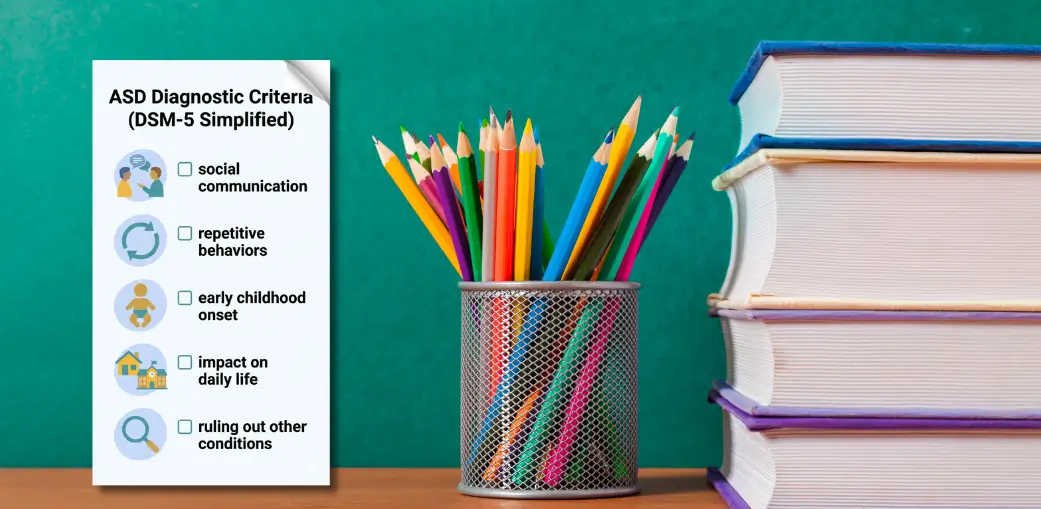
ASD Diagnostic Criteria: What Professionals are Actually Looking For:
- Persistent challenges in social communication and interaction—for example, difficulties with conversation, relationships, or emotional sharing
- Restricted, repetitive patterns of behaviour—like repeating movements, sticking to routines, or having focused interests
- Symptoms must be present from early childhood, but might not become fully obvious until demands exceed abilities
- These symptoms cause difficulties in everyday life (at home, school, or in social situations)
- Other possible explanations (such as intellectual disability) are considered and ruled out
While this may sound technical, the takeaway for parents is that professionals aren’t just looking at isolated behaviors; they’re looking for ongoing patterns that have a real impact on your child’s life.
For a longer and more detailed look at the criteria needed to meet the DSM-5 Autism Criteria, according to the APA (American Psychiatric Association), take a look here.
What are the types of behavior that may meet the diagnostic criteria for Autism?
It is natural to wonder if what you observe in your child is just part of growing up or if they might point to something more- something like Autism Spectrum Disorder, for example.
Autism Spectrum Disorder is a developmental condition that affects how people interact, communicate, and experience the world. The word “spectrum” is important—it means that children with ASD can have a wide range of strengths and challenges.
However, some behaviors may stand out and be key to receiving a diagnosis. These include:
- Consistently avoiding eye contact or not responding to their name
- Limited use of gestures, pointing, or showing objects to others
- Unusual patterns of play—like lining up toys rather than playing “pretend”
- Repetitive movements (hand flapping, rocking)
- Strong resistance to changes in routine
- Delayed speech or difficulty with two-way conversations
Is my child’s behavior “normal” or something more?
Autism can be complex to identify, as its traits often overlap with other conditions, and the signs of autism can look different from one child to the next. There’s also no “one test” that can definitively diagnose autism.
Only a licensed clinician can diagnose autism, so it is very important to find the correct expert to help either confirm or ease your concerns regarding your child’s behavior.
When professionals assess a child for Autism Spectrum Disorder, they rely on what is called the ASD diagnostic criteria to guide their observations. These criteria are designed to be clear and easy for parents to understand.
In general, experts are looking for patterns in two major areas:
- Social Communication and Interaction: This means how your child relates to other people. Are there difficulties with back-and-forth conversation, understanding social cues, or making friends?
- Restricted and Repetitive Behaviors: This includes repetitive movements, strict routines, intense interests, or sensitivity to sensory experiences (such as noise or texture).
To consider an autism diagnosis, professionals look for ongoing challenges in both areas, starting from early childhood.
The key is that these behaviors are present across different settings (home, playgroup, school)—not just in one place or situation.
Am I missing something?
It’s understandable for parents to worry that they might be overlooking something important.
If you’re asking yourself the above question, here are a few signs that might warrant a consultation with a professional and a closer look at your child’s habits:
- Your child avoids social interaction most of the time (not just occasionally)
- They have difficulty sharing interests or emotions with others
- Speech and language milestones are delayed or not progressing
- They show repetitive actions or have strong reactions to changes in routine
- There are ongoing challenges with communication, play, and forming relationships
If you recognize these patterns consistently—across different settings and over time—it may be helpful to speak to a developmental pediatrician or early intervention services. Trust your instincts: you’re the expert on your child. Many children who show some of these signs may not have ASD, but an assessment can help clarify things and connect you with support if needed.
What are some of the differential diagnoses for ASD?
Not all concerns result in an Autism Spectrum Disorder diagnosis. The National Library of Medicine is a good source for a list of other possible neurodevelopmental disorders.
Some of the key ASD differential diagnoses and other related conditions include:
- ADHD: Often presents with hyperactive or inattentive behaviors that overlap with ASD, such as difficulty with focus.
- Social (Pragmatic) Communication Disorder: Involves challenges with social communication but lacks the restricted or repetitive behaviors required for an ASD diagnosis.
- Language and Communication Disorders: Delays in speech or comprehension can mimic the communication deficits seen in autism.
- Intellectual Disability (Intellectual Developmental Disorder): While often co-occurring with ASD, intellectual disability must be distinguished as the primary cause of cognitive delays.
- Psychiatric Conditions: Anxiety, depression, and obsessive-compulsive disorders can mimic or co-occur with ASD, especially in teenagers and adults.
- Medical/Genetic Conditions: Fragile X syndrome, tuberous sclerosis, and Rett syndrome are genetic conditions associated with behavioral symptoms similar to autism.
Other Neurodevelopmental or Sensory Issues: Hearing loss or sensory processing disorders may be misidentified as behavioral symptoms of autism.
If you’re unsure whether to pursue an assessment, consider the impact of your child’s behaviours on family life, social relationships, and learning.
Here are some steps you can take:
- Start with a conversation: Reach out to your GP, health visitor, or a trusted teacher here at EA schools. Share your observations and ask for their perspective.
- Ask about local resources: Many communities have early intervention teams, support groups, and assessment clinics.
- Take your time: There’s no “right” moment to seek help. If you’re worried, it’s better to ask questions early and explore your options.
Getting an Autism Spectrum Disorder Diagnosis
The first question you may have is: Who can diagnose my child?
Should a diagnosis be given and your child require a special education setting, the referral process at EA schools is easier than you think.
Once a concern has been identified, the following steps will be taken:
- A request for evaluation in special education
A Full Individual Evaluation (FIE) must be requested in writing. - The evaluation is conducted.
A full evaluation is carried out by a team of professionals within the school setting. It takes a detailed look at your child’s strengths and challenges, and can include:- Tests for learning, speech, or cognitive skills
- Observations in class
- Interviews with you and your child’s teachers
- Reviews of work samples and grades
An assessment, or lack thereof, can provide clarity, reassurance, and access to support if needed.
It doesn’t label or limit your child—it helps you understand their needs and strengths so you can advocate for them effectively.
Experts agree that early identification and support can make a big difference for children with Autism Spectrum Disorder. That doesn’t mean rushing to a diagnosis—it means taking a thoughtful approach. If you have concerns, professionals recommend:
- Observing and recording behaviours: Keep a simple journal of what you’re seeing, when you’re seeing it, and in what settings. This can help professionals get a clear picture.
- Talking to your GP or health visitor: They can offer reassurance, guidance, and referrals if needed.
- Communicating with your child’s preschool or school: Teachers often notice social and communication differences in group settings, and can provide valuable insights.
- Avoiding alarm: Remember, many developmental differences can resemble ASD but may resolve over time or with the right support.
If you’ve been searching for an autism diagnosis in Ohio, REACH offers a clear, compassionate path forward. Their goal is to replace confusion and frustration with understanding and a solid care plan.
The main message is that you don’t have to figure this out alone. Some caring professionals understand your concerns and can guide you through the process step by step.
EA’s Coral Autism Program- a personalized approach
EA schools run a school-day program called the Coral Autism Program. This method supports the social and emotional needs of children on the autism spectrum.
Licensed teachers, classroom aides and supplementary staff employ evidence-based best practices tailored to every child to help build an inclusive, safe, and academically appropriate learning environment.
Scheduling a tour will afford you the chance to see firsthand the cohesive approach of the full team. A team that integrates EA teachers, parents, the school district, and any outside professionals (such as speech pathologists and occupational therapists) that play a role in your child’s care.
Parenting is full of questions, and concerns about Autism Spectrum Disorder can feel overwhelming at times.
Whether or not your child has ASD, your love and advocacy matter most.
Your child, and your family, are on a journey—and you don’t have to walk it alone.
EA schools are here to help guide you on that path.