Can a school deny a 504 plan? The short answer is yes. A public school can deny a 504 plan. But it must have a legal reason to do so.
Section 504 of the Rehabilitation Act of 1973 protects students with disabilities. Public schools must give these students reasonable accommodations. This gives them equal access to education.
A school can say “No” to a 504 plan. But it must first review the child’s needs. That review may show that the child does not meet the legal rules for a disability under Section 504.
This can be very frustrating for parents. Many can’t afford a private attorney to fight the school board. Others fear the school may treat their child unfairly if they fight the decision. The good news is that you don’t need a lawyer. Federal law bans school staff from taking action against parents who ask for accommodations.
If your 504 plan was denied, start by asking the school to put its decision in writing. That gives you something to check and challenge. To learn who qualifies for a 504 plan, read our guide on Understanding 504 Plans for Students.
Reasons a school can’t use to say “No”
A school must have a valid reason to deny a 504 plan. That reason must be based on its review of the child. A school can’t say no because it lacks money or staff. It also can’t deny a plan just because it would be hard to provide.
Parents may still hear reasons that are not valid under the law. Here are some common examples.
“Your child gets good grades.” Good grades don’t rule out a 504 plan. A child with ADHD or dyslexia may work much harder than other students to earn those grades. The child may also be under great stress. Section 504 looks at how a condition affects a major life activity. Grades alone don’t decide whether a child qualifies.
“We don’t have the budget or staff for these accommodations.” A school can’t use a lack of money or staff to deny a student access to civil rights accommodations.
“It’s just a behavioral issue, not a disability.” Behavior issues may be linked to ADHD, autism, or another condition. The school can’t simply dismiss the request. It must do a proper review first.
“We already offer informal help in the classroom.” A teacher’s promise to help is not a formal plan. A child may need accommodations for equal access to education. If so, the child has a right to a written plan. That plan follows the child from grade to grade.
“They said we need a doctor’s note first”
Parents are often told, “We can’t process a 504 plan until you bring us an official medical diagnosis from a doctor.”
Is a medical diagnosis required for a 504 plan?
The answer is “No.” Federal law does not require a doctor’s diagnosis. A school can review a child for a 504 plan without one.
The school district must look at information from several sources. A diagnosis or a doctor’s note can help. But the 504 team must consider other information, including:
- School tests and test scores
- Teacher input and classroom observations
- Health records and physical condition
- Private psychological or behavior evaluations given by parents
- Parent observations and the child’s history
What if the school says a medical exam is needed to decide if your child qualifies? In that case, the school district must pay for it. A public school can’t force you to pay for a medical diagnosis before your child can qualify for Section 504.
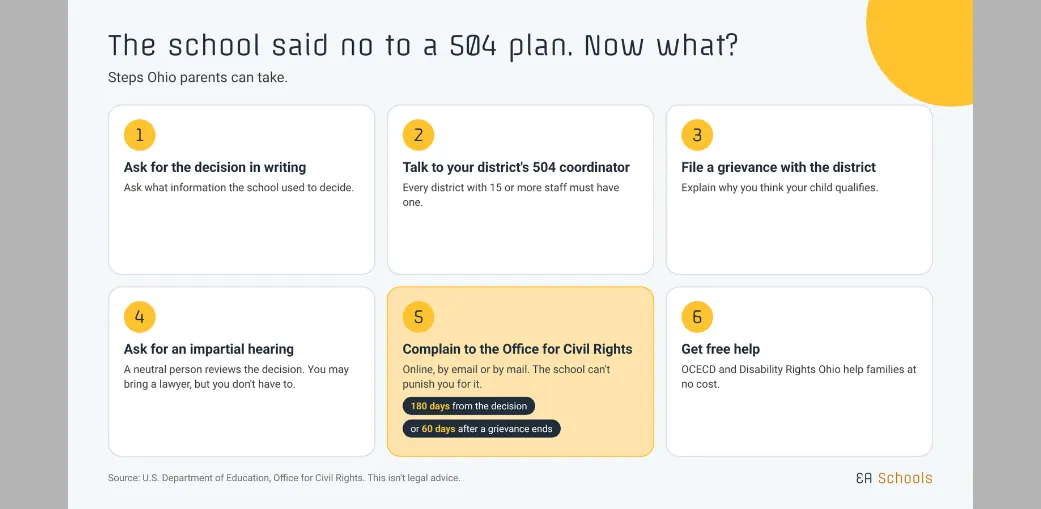
What to do if the school says no
If your child’s 504 request was denied, you don’t have to accept “no” and walk away. You can take steps to protect your child’s educational rights.
- Get the decision in writing: Ask the school for a written refusal. This is sometimes called Prior Written Notice. It should explain what information the school used to make its decision.
- Contact the District 504 Coordinator: Every public school district in Ohio with 15 or more staff must have a staff member who oversees Section 504. Contact this person, not just the principal. Ask them to review the decision.
- File a grievance with the district: School districts must have a way to handle these disputes. You can file a written grievance. Explain why you believe the facts show that your child qualifies for a 504 plan.
- Ask for a hearing or file an OCR complaint: You can ask the school district for an impartial hearing. You can also file a discrimination complaint with the US Department of Education Office of Civil Rights (OCR). Note: you usually have 180 days from the school’s decision to file an OCR complaint. If you use your district’s grievance process first, you have 60 days after it ends to file with OCR.
- Talk to an advocate or attorney: If those steps don’t solve the problem, you can talk to an education attorney. Free state advocacy groups may also be able to help.
Has the school mentioned an IEP or an autism evaluation?
That’s a different path, and some children need more support than a regular classroom can give. EA Schools works with Ohio districts and families to find the right placement.
[ See if EA Schools is the right fit ]
When a 504 isn’t enough
Sometimes a 504 plan may not give a child enough help. This may be true if your child’s needs are more serious. It may also be true if accommodations aren’t helping your child make progress in school.
Your child may need an Individualized Education Program (IEP) instead. In Ohio, you can start by asking the school for a full special education evaluation. This is called an Evaluation Team Report (ETR).
If you think your child needs special instruction, these resources can help:
- IEP Meeting Tips for Parents
- Questions to ask at your child’s IEP meeting in Ohio
- Transition Plans for Students with Disabilities in Ohio
- What Happens After an Autism Diagnosis?
A Note on EA Schools:
A Section 504 plan alone does not qualify a child for EA Schools. A 504 plan is not considered special education. EA Schools accepts students through district referrals, an active IEP, or a documented autism diagnosis. We do not offer 504 advocacy or private evaluations for general education students.
If your school district agrees that your child needs more support, our Coral Autism Program and REACH Behavioral Health may be able to help. These programs are designed for children with greater learning or behavior needs.
What if the 504 plan isn’t being followed?
What if they agreed to a plan but aren’t following it? This can be just as frustrating as having a plan denied.
Federal law requires school staff to follow an approved 504 plan. This includes teachers and elective staff. If your child is not getting the required accommodations, here’s what you can do:
- Keep a record: Write down each time an accommodation was not provided. Include the date, assignment, and what happened.
- Email the teacher: Remind the teacher about the accommodations in your child’s 504 plan. Do this in writing and attach a copy of the plan.
- Contact the 504 coordinator: If the problem continues, ask for a 504 review meeting. Include the district’s 504 coordinator and school leaders.
- File a grievance: If the school still does not follow the plan, file a complaint with your district. You can also file a formal complaint with the US Department of Education Office of Civil Rights.
Free help for Ohio families
If you’re in a 504 dispute with your local public school, free help is available in Ohio. These groups help parents with Section 504 and special education issues.
- Ohio Coalition for the Education of Children with Disabilities (OCECD): The OCECD is Ohio’s federally funded Parent Training and Information Center. It gets federal funds to help families for free. It offers guides, sample letters, and parent mentors. These can help you learn your rights and work with your school district.
- Disability Rights Ohio (DRO): DRO protects the rights of Ohio residents with disabilities. It can offer help with 504 and IEP disputes with public schools.
For families whose child may need special education
Can a school deny a 504 plan? Yes. But if your child is still struggling, a 504 may not be the right tool.
Was your child’s 504 request denied? Has your school district suggested an ETR? If so, a standard classroom may not give your child enough support.
EA Schools works with Ohio school districts and families. We help children who need special education and behavior support beyond what a general classroom can provide.
If your child has an IEP or an autism diagnosis, explore our Enrollment Options. You can learn how district referrals and placement work.
FAQs
How do I request a 504 plan?
Send a written letter or email to your school’s principal and district 504 coordinator. Tell them that you’re asking for a formal evaluation under Section 504 of the Rehabilitation Act. Explain your child’s condition and how it affects daily life and learning at school.
What goes in a 504 plan request letter?
A strong 504 plan request letter should include:
- Your child’s full name, grade, and school
- The specific condition or diagnosis
- Examples of major life activities affected at school
- A formal request for a 504 eligibility meeting and evaluation
- Copies of supporting documents, if available (medical notes, private therapy reports, etc.)
How often are 504 plans reviewed?
Federal law says schools must re-evaluate students with a 504 plan “periodically.” It doesn’t set an exact schedule. Many Ohio districts review the plan once a year. Many also do a full re-evaluation every three years. A school must also re-evaluate your child before making a big change to where or how they’re taught. Ask your district what its schedule is.
What happens during a 504 eligibility meeting?
Parents and school staff meet to review the evaluation data. School staff may include teachers, counselors, nurses, and administrators.
The team decides if the student meets two legal requirements. First, the child must have a physical or mental impairment. Second, the condition must substantially limit a major life activity. If the student is eligible, the team drafts accommodations.
Can a school cancel or remove a 504 plan without parental consent?
A school can cancel a 504 plan if a re-evaluation shows that the student no longer has an impairment that substantially limits a major life activity. However, the school must give parents Prior Written Notice explaining why the plan is ending. The school must also tell parents about their right to appeal or request a hearing.